Welkom by die webjoernaal van die Warmbad Renaissance-aftreeoord, Bela-Bela

Welcome to the blog of the Warmbad Renaissance Retirement Village, Bela-Bela

Soek 'n berig in Renaissance

Soek jy na 'n berig in hierdie webjoernaal? Volg die aanwysings hieronder.
Showing posts with label Village. Show all posts

Saturday, 27 June 2020

Lilies of the African landscape

Our resident environmentalist, PHILIP VAN DEN BERG (U34), writes: Aloes are often spoken of as lilies of the African landscape. They vary in size from minute dwarf-like plants to huge trees.  Believe it or not, there are examples of all these shapes of aloes growing in our village. A few of those appear in the photographs below. They display flashes of colour; some of them in reds, others in oranges and yellows, a few of them pastel pale, but most of them bright and intense.


In their various forms, shapes and sizes, aloes are a distinctive feature of the many different landscapes, contributing to the wealth of the floral kingdom of the southern tip of Africa.

Being hardy and drought-resistant plants, aloes are ideal garden plants for a dry and hot place such as Bela-Bela. They do, however, need well-drained soil, enough sunlight, sufficient food and some attention as a thriving, vigorous plant will be less prone to pests and diseases. White scale is a common pest in our village but can be treated by modern aerosol contact insecticides, systemic insecticides or simply by spraying the plants with a mixture of washing powder, alcohol and water.

Another serious disease is aloe cancer. Do not try to treat this – simply remove the plants.

Thursday, 16 April 2020

Lockdown in our village

President Cyril Ramaphosa announced on 22 March that South Africa will enter a nationwide lockdown with effect from midnight on Thursday 26 March as part of efforts to curb the rapid spread of COVID-19 in our country.

The Management Committee subsequently issued a circular in support of our President’s appeal, announcing that all formal village activities are to be suspended until further notice.

A brief overview of the ways in which our residents are dealing with the lockdown, appears below.

Roger Kennard (U117) remains busy by pottering in his garage
John and Colleen Meredith (U50) are doing their own thing at their own pace
Delene  Bekker (E58) is 'n geesdriftige tuinier. Sy woon al 26 jaar lank in die oord
Philip en Ingrid van den Berg (E34) is koorsagtig aan die werk om hulle nuutste boek persklaar te kry
Marlene and Dave Bisset (U123) remain fit by taking a brisk 35-minute walk in the village every day

Wednesday, 1 April 2020

A slice of village life

Our PT Group has been in existence for almost three years. Participants voluntarily place a donation to CANSA in a pink box. To date R12 325 has been paid over to CANSA. Here Rina Steynberg presents our donation to a local CANSA representative, Ansie van Heerden.

Street braais are popular in our village
Any excuse is a good excuse for a friendly chat
Darts is a popular pastime. In fact, the darts club was established in 1995 and is still going strong
Our library, containing almost 7 000 books, is a much visited place
Snooker is also a popular pastime. This picture was taken in 2007
The Social Action stalwarts produce the best vetkoek in the Bushveld
Flip Dreyer (aka Flip Spanner) and his trusted assistant, Bra Willy (William Baloyi), on their way to a call-out. Flip heads the Maintenance Portfolio and William has worked at the village since  May 1996.
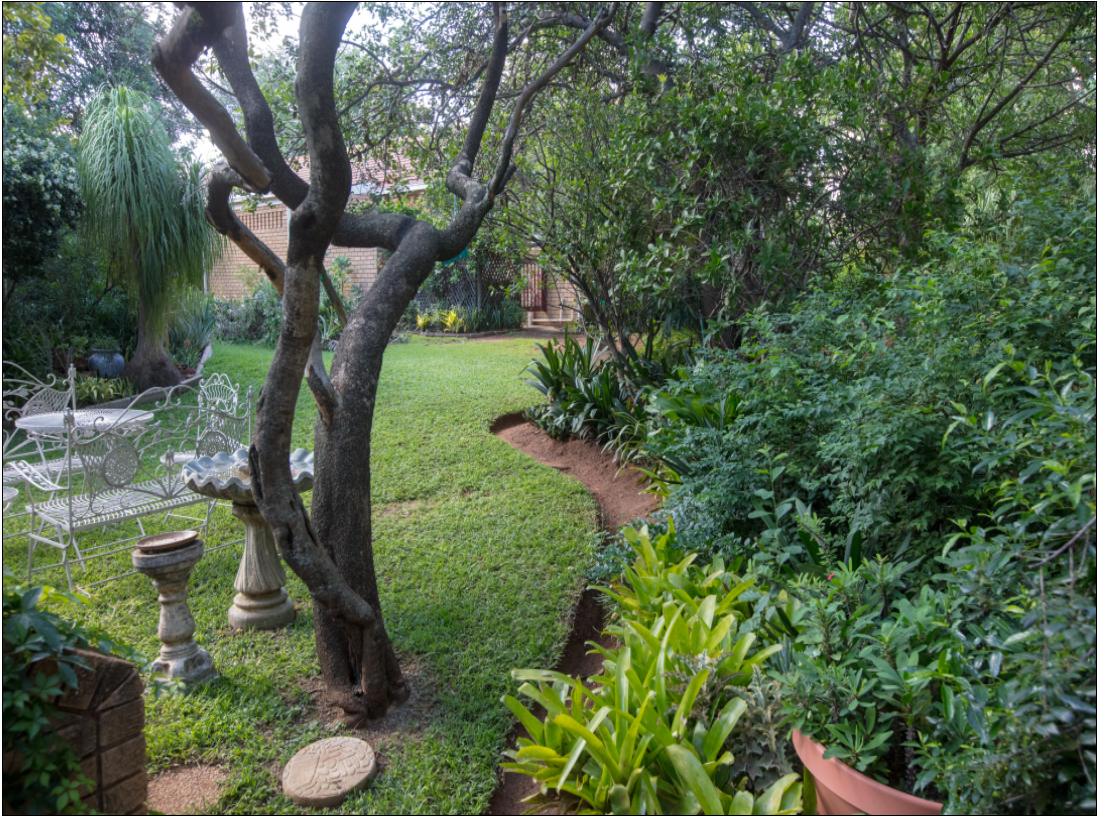
Most of our residents are keen gardeners


Saturday, 15 February 2020

Our place. Our pride

Since the origin of our village almost thirty years ago, residents have shown pride in their environment, developing and caring for the area around their units at their own cost.

The pictures below are ample proof of this.


In 1991 the developers of our village took care not to damage indigenous trees, thereby setting an example to be followed over the years to come
The ensuing tradition about caring for our environment is perhaps best demonstrated by a tree-planting ceremony held in 1994
Are we tree-huggers? Absolutely!
The two photographs below are examples of the pride our residents take in their surroundings. They show Annatjie and Mynhard Maree's garden at U25.


Sunday, 17 November 2019

Year-end Function - 2019

Our residents have paid tribute to the Social Action for producing seven excellent functions this year under the capable leadership of their convenor, Rita Vosloo. Sadly, after five years at the helm, Rita has decided to call it a day. Residents should be concerned that no-one has yet volunteered to take her place.

Their crowning achievement this year proved to be the Year-end Function that was held recently.

The photographs below provide an overview of the proceedings

F.l.t.r. are Elize Strydom, Linda Grobler, Bets Cilliers, Lettie Roode, Edna Cornelius, Ria Nel, Linkie Ellis and Rita Vosloo. Other stalwarts not appearing in the photograph are Mel Smith, Annetjie Maree, Magda van den Berg, Des Vos, Annatjie van Rooyen, Jadene Horne, Ria Bester, Hester Botes, Colleen Meredith, Elize Yeo, Annatjie du Plessis, Sheila Meyer and Eileen Laubscher
The pièce de résistance turned out to be the bushpig-on-the-spit prepared by Thys and MC van Zyl
Guests patiently waiting for proceedings to start
Residents Kobi Breedt and Elize Strydom performing hit songs of yesteryear
Zelda Nel receiving her prize from Edna Cornelius following a wine draw. Zelda is the wife of our Managing Agent, Frikman Nel
Dinner is served
The aftermath

Sunday, 3 November 2019

Remarkable mimicry

A Diederik Cuckoo
PHILIP VAN DEN BERG (U34), writes:  Residents are probably well acquainted with the ‘dee-dee-dee-deederik’ call of Diederik Cuckoos during the summer. These birds are migratory intra-African brood parasites. They have a range of host species including Southern Masked Weavers.

One of the most astonishing features of Diederik Cuckoos is that they lay eggs that match the colour and markings of the host species.

When the female Diederik Cuckoo enters the host nest, she ejects or eats the host’s eggs. Then she lays only one egg in the nest.

The female ejects or eats the host's eggs
The egg hatches within 10 to 12 days, and the parasite chick receives the undivided attention of the host parents. In the picture below the host parent is a Southern Masked Weaver.

A Southern Masked Weaver feeding a Diereik Cuckoo chick
The fledgling remains dependent on its host parents. As winter approaches it flies back to Equatorial Africa purely on instinct.

Saturday, 28 September 2019

Die Waterberg - Inleiding

Vroeër vanjaar het hierdie webjoernaal ’n reeks artikels geplaas oor aspekte van die geskiedenis van ons dorp. In die volgende reeks span ons die net wyer ten einde ons groter omgewing onder die loep te neem: die Waterberg.

Alhoewel ʼn verskeidenheid bronne uiteraard geraadpleeg sal word, is ons hoofbron die uitstekende webtuiste met teks, kaarte, foto’s, ens. wat deur Warwick en Marlene Tarboton van Modimolle behartig word. Die titel daarvan is Waterberg BioQuest/BioSoektog.

Die Waterberg is asʼt ware op ons voorstoep geleë. Die naam van die bergreeks is afkomstig van die sandsteenformasies wat voldoende water behou om ʼn volhoubare habitat vir mens en dier te vorm.

Die Waterberg is asʼt ware op ons voorstoep geleë. Bela-Bela lê heel suid
Die Waterberg is in wese ʼn verhewe plato, gevorm soos ʼn groot omgekeerde piering wat sowat vier- tot vyfhonderd meter bo die omringende Springbokvlakte uittroon. Die plato bereik sy hoogste punt van 2088 meter bo seevlak in die Marakele Nasionale Park.

Die Waterberg troon sowat vier- tot vyfhonderd meter bo die omringende Springbokvlakte uit (Foto: Warwick Tarboton)
Die gebied strek vanaf Mokopane in die ooste tot by Thabazimbi in die weste. Vaalwater vorm die middelpunt. Dit word aan drie kante deur majestueuse kranse begrens.

Die skouspelagtige kranse van die Waterberg (Foto: Dries de Jager)
Die Waterberg beslaan ongeveer 14 000 m². Dis gelykstaande aan sowat tweederdes van die oppervlakte van die Nasionale Krugerwildtuin.

Die gebied word deur verskeie  riviere gedreineer, onder andere die Mogol, Palala, Mothlabatsi, Sterk, Mogalakwena en Sand.

Die waarde van die Waterberg vir biodiversiteit is geleë in die feit dat populasies van ongeveer 2000 plantspesies hier voorkom. Hiervan het ongeveer 30 ʼn beperkte verspreidingsgebied en is òf skaars òf bedreig. Sowat 119 soogdierspesies, 98 reptielspesies, 447 voëlspesies, 242 skoenlapperspesies en 91 spesies naaldekokers en waterjuffers is onder andere hier opgeteken.

Die Waterberg word relatief yl bewoon en groot dele word aangewend vir bewaring en wildboerdery.

Sunday, 8 September 2019

An animal without a what?!

 Philip van den Berg 
Our in-house environmentalist, PHILIP VAN DEN BERG (U34), writes: In our village live animals without a mouth or an anus. They are called antlions.

These wonderful creatures live most of their lives underground in conical pits they make in dry, sandy areas.

Conical pits
At the bottom of the pit, buried in the sand, is this squab creature with its sharp, curved jaws. If an insect walks into one of these pits it will stumble down the loose, sandy sides.

Antlion in its pupal stage 
The antlion will immediately start squirting up sand resulting in the hapless victim sliding down into its formidable jaws. The antlion will then commence sucking out its body juices.

Because the antlion does not have an anus, all the metabolic waste generated is stored and eventually voided at the end of its pupal stage before its transformation into an adult insect resembling a dragonfly. As soon as the adult's wings are fully opened, it flies off in search of a mate.

Antlion in its transformed adult form

Monday, 24 June 2019

The history of our town - The streets of Bela-Bela

This article is the sixth and last of a series about the history of our town.

In previous editions we reported on the historical link between Bela-Bela (formerly Wambaths) and various locations in South Africa. This issue focusses on the historical link between our town and the University of the Witwatersrand, colloquially known as Wits.

Shortly after Warmbaths was proclaimed as a township in 1920, a competition to design the layout of the town was held. The competition was won by a successful architect/town planner of Johannesburg called John Abraham Moffat.

This picture shows the layout of the streets of Bela-Bela as designed by John Abraham Moffat
Although it is logical to assume that Moffat Rd. was named after John Abraham Moffat, this could not be verified as a fact.

This street was almost certainly named after Moffat
Despite an extensive search, The author was unfortunately unable to trace a picture of Moffat.

The question now arises: who was John Abraham Moffat, and how does Wits fit into the picture?

Moffat was born in Manchester, England, in 1871. As a child he left with his family for New Zealand either in 1872 or 1876. After a short time in New Zealand the family settled in Sydney, Australia before moving to Brisbane, where he attended the Brisbane Technical College, presumably to study architecture.

In 1895 Moffat came to South Africa. During the Anglo-Boer War he joined the British forces and helped to design hospitals, defence works, block-houses and concentration camps.

He settled in Johannesburg in about 1902 and became a highly respected architect, designing various buildings in Johannesburg.  Moffat soon developed an interest in town planning, an involvement lasting for most of his career. For example, in 1904 he designed the layout of Waverley, a residential suburb in Johannesburg.

After his death in 1941, he bequeathed £100 000 to Wits. The money was used to erect the building now known as the John Moffat Building for the School of Architecture.

The John Moffat Building for the School of Architecture on the Wits campus

Tuesday, 21 May 2019

The history of our town - Our own blockhouse, "a curious hybrid"

We previously described the historical connection between our town and the Langkloof in the Eastern Cape where Coenraad de Buys was born. Click HERE to access. Buyskop, approximately five kilometres from Bela-Bela on the way to Modimolle, is named after him. In this article we shall explore the link between Bela-Bela and Noupoort. 

In 1900 Lord Kitchener succeeded Lord Roberts as commander-in-chief of the British forces in South Africa during the second Anglo-Boer War. He soon became the driving force behind actions designed by Roberts to weaken Boer resistance: bur-ning their farms, destroying their livestock and herding their women and children into concentration camps.

Lord Kitchener
By the way, the Times History of the War observed that this policy had “nothing to recommend it and no other measure aroused such deep and lasting resentment. [It] was the least happy of Lord Roberts’ inspirations and must plainly be set down as a serious error of judgment … “

Kitchener decreed that blockhouses should also be erected from January 1901 onwards to protect the railway lines from marauding Boer guerrilla fighters. Near important bridges they were substantial stone-built structures, but for the most part their walls were of double-skinned corrugated iron filled with earth and gravel and pierced by loopholes. These were deemed sufficient as the Boer guerrillas were only armed with rifles.

An example of a corrugated iron blockhouse
The blockhouse system, which played such a large part in the conclusion of military operations in South Africa in 1902, is shown on the map below.

The blockhouse system shown here as dots on a relief map
By the end of the war some 8 000 blockhouses had been erected, providing the links in almost 6 000 km. of fortifications.

One of the original stone-built blockhouses is to be found in Bela-Bela at the vehicle testing grounds in the industrial area. Its purpose was to protect the railway station.

Our blockhouse formed part of the line of blockhouses from Noupoort to Polokwane, a distance of almost 1 000 km. Today it is a national monument and, until recently, regarded as one of the best preserved in the country.

Map showing the distance from Noupoort to Polokwane. Our town is about 100 km north of Pretoria
In an excellent article (see http://samilitaryhistory.org/vol106rt.html) about the blockhouse system, Richard Tomlinson describes our specimen as a “curious hybrid”.  Most of the other stone-built blockhouses were three-storey structures. Ours was originally two-storeyed with two loopholes in each wall on the ground floor and a first floor entrance facing the railway line. At roof level there were crenellated pa-rapets 1,8 m high. The parapets were later extended upwards and a pyramidical corrugated roof, as well as a weather vane, were added.

Our very own blockhouse

Sunday, 24 March 2019

The historical link between Bela-Bela and Blood River

This article is the fourth in a series about the history of our town that may be of interest to residents of our village.

Hands up those who know of the historical connection between Bela-Bela (formerly Warmbaths) and Blood River in KwaZulu-Natal? Blood River is located on the R33 between Dundee and Vryheid, approximately 600 km as the crow flies from Bela-Bela.

The two main actors in this saga were Andries Wilhelmus Jacobus Pretorius and his wife, Christina Petronella Pretorius.

Commandant General Andries Pretorius
Andries (1798 – 1853) achieved fame as the leader of 470 Voortrekkers who fought against a large Zulu impi estimated at 10 000 to 15 000 on the bank of the Ncome River on 16 December 1838.This battle later became known as the Battle of Blood River. Three Voortrekkers were injured, including Andries, who was stabbed in the hand. Zulu casualties amounted to more than 3 000.

The Battle of Blood River
The Voortrekkers believed that God granted them victory and therefore promised that they and their descendants would commemorate the day of the battle as a day of rest. It was memorialized as Dingaan’s Day but was later renamed as the Day of the Covenant. Since 1994 the democratically elected government kept the day as a public holiday as an act of conciliation, but renamed it the Day of Reconciliation.

Andries Pretorius was involved in the establishment of the short-lived Voortrekker Republic of Natalia in 1839. In 1852 he was also instrumental in the founding of the Zuid Afrikaansche Republiek. The city of Pretoria is named after him.

Andries married Cristina de Wit (1799 – 1848) in 1818 when she was 18 years old. They had 13 children before she passed away in Warmbaths at the age of 48 where she was brought after a bout of flu. It was hoped that the mineral waters would restore her health. 

History books tell us very little about Christina. In fact, we were unable to find a picture of her. However, judging by the epitaph on her gravestone which was erected in the Voortrekker Cemetery behind the present-day Bela-Bela Municipal Office she must have been a patriotic person. The epitaph reads, “Gaan Andries, jou landgenote het jou nodig; kyk wat jy vir hulle kan doen; my kan jy die lewe tog nie gee nie.”

Christina Pretorius' grave
There is an element of sadness in the fact that, in the year of her death (1848), Andries heeded her plea to continue serving his countrymen because they needed him. For example, he led the Voortrekkers in their "war of freedom" against the British, occupying Bloemfontein on 20 July 1848. In August 1848, he was defeated by the British at Boomplaats.

One wonders, was he with her when she died?